Ten

Anthem
        -- Leonard Cohen

The birds they sang
At the break of day
Start again
I heard them say
Don't dwell on what has passed away
Or what is yet to be
Ah, the wars they will be fought again
The holy dove, she will be caught again
Bought and sold, and bought again
The dove is never free

Ring the bells that still can ring
Forget your perfect offering
There is a crack, a crack in everything
That's how the light gets in

We asked for signs
The signs were sent
The birth betrayed
The marriage spent
Yeah, and the widowhood
Of every government
Signs for all to see

I can't run no more
With that lawless crowd
While the killers in high places
Say their prayers out loud
But they've summoned, they've summoned up
A thundercloud
They're going to hear from me

Ring the bells that still can ring
Forget your perfect offering
There is a crack, a crack in everything
That's how the light gets in

You can add up the parts
But you won't have the sum
You can strike up the march
There is no drum
Every heart, every heart
To love will come
But like a refugee

Ring the bells that still can ring
Forget your perfect offering
There is a crack, a crack in everything
That's how the light gets in

Ring the bells that still can ring
Forget your perfect offering
There is a crack, a crack in everything
That's how the light gets in

https://youtu.be/6wRYjtvIYK0

How the Light Gets In

Slow, 
inexorable, 
it seeks 

the finest 
fractures in 
the smallest 

bones, 
and sinks in
there

like sunlight 
bleeding
through 

black snow,
down 
to the deepest

shadows,
stirs
the still heart

into
stuttering
again,

into 
love, first word
and last --

Suggested soundtrack: Leonard Cohen, of course. Anything by.
Nine

What Kind of Times Are These
        --- Adrienne Rich

There's a place between two stands of trees where the grass grows uphill
and the old revolutionary road breaks off into shadows
near a meeting-house abandoned by the persecuted
who disappeared into those shadows.

I've walked there picking mushrooms at the edge of dread, but don't be fooled
this isn't a Russian poem, this is not somewhere else but here,
our country moving closer to its own truth and dread,
its own ways of making people disappear.

I won't tell you where the place is, the dark mesh of the woods
meeting the unmarked strip of light—
ghost-ridden crossroads, leafmold paradise:
I know already who wants to buy it, sell it, make it disappear.

And I won't tell you where it is, so why do I tell you
anything? Because you still listen, because in times like these
to have you listen at all, it's necessary
to talk about trees.

https://www.poetryfoundation.org/poems/51092/what-kind-of-times-are-these

Talk about Trees

This morning Mom and I spoke for over an hour over
the Utah father who shot his five children, his mother-in-law,
his wife, leaving a note about her hellish "manipulation," how
he'd "asked for help" but no one listened, 

when what really happened was she filed for divorce, 
and his daughter told friends she was happy they were finally 
kicking the "jerk" out of the house, that she just wanted 
to feel safe,

and clearly, Mom said, he thought of his family as possessions, 
felt his control slipping away, interpreted their wish to live free
as a threat to his existence, and so wiped them off the planet, 
rewrote the narrative, cast his wife as the witch and himself 

the poor man facing the oven. And then we let the conversation 
drift as it always does back to our own traumatic house
and its twisted father, a gin-soaked fabulist who believed his own
lies -- stories of madness and female anarchy invented

to explain our rejection of his rule, his reputation as a man,
stories of wayward women hacking at the trunk of his
patriarchal tree with hysterical axes. Shit, we finished,
he died almost ten years ago now. Time to change

the subject. "I'll write my poem in response to the letter,"
I said. "The Utah guy's?" Mom clarified. "Yes." But then
I discovered that I didn't want to document (again) the sad
script of another white father shooting his house down

to publish homicidal fantasies of divine dispensation, 
especially not on Easter. Leave those words unread. 
Instead, let's end with the image of the old trees 
that still survive on our midwestern city street -- 

maples whose roots push on, tortured, persistent,
under the surface of our concrete and chemical lawns.

Suggested soundtrack: Buffalo Springfield, “For What It’s Worth”

Eight

"Tenuousness"
         -- Andrew Bird

Tenuous at best was all he had to say 
When pressed about the rest of it, the world that is
From proto-Sanskrit Minoans to Porto-centric Lisboans
Greek Cypriots and harbor sorts who hang around in ports a lot uh huh

Here's where things start getting weird
While chinless men will scratch their beards
And to their minds a sharpened axe 
Is brushed upon the Uralic syntaxes

Love of hate acts as an axis
First it wanes and then it waxes
So procreate and pay your taxes

Tenuousness, less seven comes to three
Them, you, us plus eleven 
Thank the heavens for their elasticity 
And as for those who live and die for astronomy

When coprophagia was writ
Know when to stand or when to sit
Can't stand to stand, can't stand to sit
And who would want to know this?
Click, click, click

Who wants to look upon this? 
Who wants to look upon this pray tell?
Who wants to look upon this?
Who wants to look upon this pray tell, pray tell?

Tenuousness, less seven comes to three
Them, you, us plus eleven comes just shy of infinity 
And as for those who live and die from numerology

https://youtu.be/I9rmwllw5q8

Coprophagia
             for Andrew Bird

I want to climb my way through 
         elevated words at once crunchy and dark,

multisyllabic latinate 
         homages to the Anglo-Saxon lexicon, 

scale mellifluous and strange up a 
         calligraphic ladder, 

scintillating, enigmatic, half euphoric, 
        epiphanic, breathing 

psychedelic diction, regurgitating 
         divine dictation, 

transcribing sacramental gibberish
         like an authentic citizen 

of ancient Babel, high and higher on her 
        impossible transcendental tower,

seeking with the best of them a peek
        at the Ultimate Power --

I want to fly like her, a legend in
        her own mind, and poise

at the top, one foot raised 
        in the second before

the fatal blow, flicker, click, linguistic
        deliquescence --

Required soundtrack: Andrew Bird’s Noble Beast.

Seven

"oh antic God"
      -- Lucille Clifton

oh antic God
return to me
my mother in her thirties   
leaned across the front porch   
the huge pillow of her breasts   
pressing against the rail
summoning me in for bed.

I am almost the dead woman’s age times two.

I can barely recall her song
the scent of her hands
though her wild hair scratches my dreams   
at night.   return to me, oh Lord of then   
and now, my mother’s calling,
her young voice humming my name.

https://www.poetryfoundation.org/poems/46670/oh-antic-god

Return to Me

Oh God of cold wars,
return to me my father 
before he died, 
in a body you didn't let me
remember;

recall his warm smell, the 
soft brush of chest 
against my cheek, his heart
pumping, his lungs filling, his strong arms 
around my back, pulling me 
in.

If he sang to me, I don't know.
And if he did, I can't hear how 
his voice sounded, or
the song he chose to sing.

So bring him back, oh God of 
mistakes, of radiation, of
bombs and deserts and clouds, 

if only 
in my dreams.

Give him the radiant flesh 
of an atomic angel so that
he can hold me in his 
electric arms
again.

Suggested soundtrack: James Taylor, “Fire and Rain”

Six

Keeping Things Whole
        -- Mark Strand

In a field
I am the absence
of field.
This is
always the case.
Wherever I am
I am what is missing.

When I walk
I part the air
and always
the air moves in   
to fill the spaces
where my body’s been.

We all have reasons
for moving.
I move
to keep things whole.

https://www.poetryfoundation.org/poems/47541/keeping-things-whole

We All Have Reasons / for Moving

Often, I do it 
because 
wherever I am
becomes, as a result, 
somewhat
unpleasant; thus

I attempt to inhabit
someone else's
space. Un-
fortunately, though,

wherever I go
there I am, 
and so I must find
another place 
to be, 
etcetera and so forth
ad nauseam.

Suggested soundtrack: Anything by The National.

Five

Addiction Sonnet
       -- Sharon Olds

A prejudice is an addiction, and it’s
contagious—parents infect their children.
And addiction’s obsessive, if a man finds it
difficult to show his love to his
son, it may be because his father
escaped with his life from the village in which
his own father had just been murdered
in a pogrom, his model as a father
a man in terror.
But addiction to such a silence can be
healed, as Carl and his son tried to do,
through hard work. Workers of the world,
unite, we have nothing to lose
but the death of the earth.

https://www.poetryfoundation.org/poetrymagazine/poems/159807/addiction-sonnet

Death of the Earth Sonnet

Perhaps we are all addicted to prejudice.
Maybe we stubbornly love what promises
to kill us. Could be that our parents are born
into murder, bloodstream memory, and it runs

through them into us hot and insistent as gun
fire in a distant jungle, the obsessive chop
chop chop of flying blades soundtrack to
genetic suicide. But our desire for terror

might at last be turned to account -- after 
the final countdown, the last triggers
pulled and buttons pushed, after the smoke
of our addiction to killing finally clears,

the earth might wake to a healing absence of
all that is human, a blessed silence.

Suggested soundtrack: Joni Mitchell, “Big Yellow Taxi” and REM, “The End of the World of the World as We Know It (and I Feel Fine)

Four

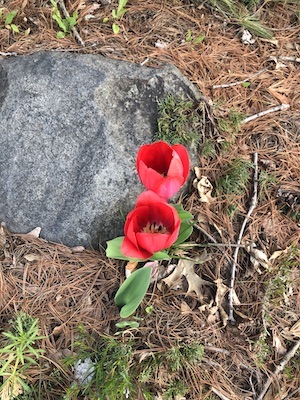
Spring
-- Edna St. Vincent Millay

To what purpose, April, do you return again? 
Beauty is not enough. 
You can no longer quiet me with the redness 
Of little leaves opening stickily. 
I know what I know. 
The sun is hot on my neck as I observe 
The spikes of the crocus. 
The smell of the earth is good. 
It is apparent that there is no death. 
But what does that signify? 
Not only under ground are the brains of men 
Eaten by maggots. 
Life in itself 
Is nothing, 
An empty cup, a flight of uncarpeted stairs. 
It is not enough that yearly, down this hill, 
April 
Comes like an idiot, babbling and strewing flowers. 

April is an Idiot

indeed, breeding lilacs and etc.

And you're right, Edna, sticky beauty --
flowering trees preparing to 
turn riot and daffodils popping 
their bulbs underground -- 
it's not nearly enough 

to distract us from hordes of
maggot-brained men and their 
empty cups of impotent (they say 
important) bluster. 

Why, even today, we again 
dragged our 
sorry asses 
to the polls, cast
votes (stones) 
against their endless campaigns to
confine us in their
pumpkin shells (because there 
they vow they will keep us,
very well), these 

womb-stealing
citizens of the fall, these
leafless November mother-
fuckers.

Suggested soundtrack: Aretha Franklin, “R-E-S-P-E-C-T”

Three


Not the Words

Grandma worshipped the god of hurricanes
who molded the world from a man made of clay,
and filled the house she lived in with his
kudzu vines, his sickly sweet honeysuckle 
sweat, his dim shadows trapped in jars of
wet marbles lining her bathroom sills.

He lay down next to her on Sunday afternoons
in the bed where her husband died, 
his hot New Orleans breath thick 
on her neck, her white skin, and shuddering up
from her lungs in choked dreams.

Before bed, she put us on our knees
in the room where our father and his brothers
lay awake for years, waiting, plotting their chance
to escape. "Now I lay me down to sleep," 
she taught us, "I pray the Lord my soul to keep."
We clasped our small hands tight on the knobby 
bedspread, bones grinding the wood floor. 
"If I should die before I wake," we said,
"I pray the Lord my soul to take."

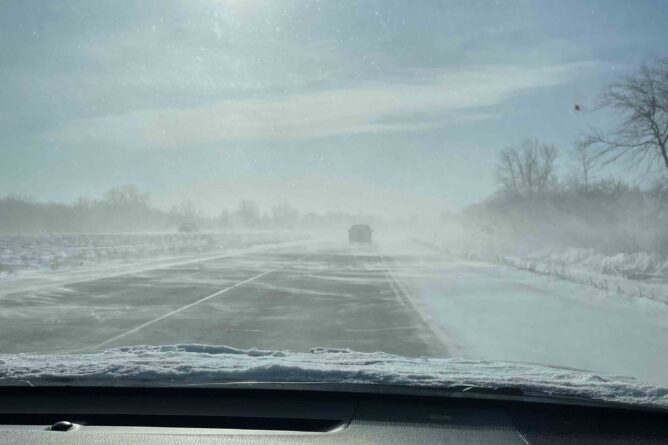
I prefer the god of hawks, who waits on the wire
along the highway, glass eyes on frozen grass, alive
to the swish and sigh of my tires, the flash of metal
I make as I speed past under December sun. 
When I die, I hope my soul flies with him into 
his wild sky, clouds and wind and snow, free
leaves, ruffled feathers, cold joy.

Suggested soundtrack: The Pretenders, “Brass in Pocket.”

Two

Musee des Beaux Arts
W. H. Auden

About suffering they were never wrong,
The old Masters: how well they understood
Its human position: how it takes place
While someone else is eating or opening a window or just walking dully along;
How, when the aged are reverently, passionately waiting
For the miraculous birth, there always must be
Children who did not specially want it to happen, skating
On a pond at the edge of the wood:
They never forgot
That even the dreadful martyrdom must run its course
Anyhow in a corner, some untidy spot
Where the dogs go on with their doggy life and the torturer's horse
Scratches its innocent behind on a tree.

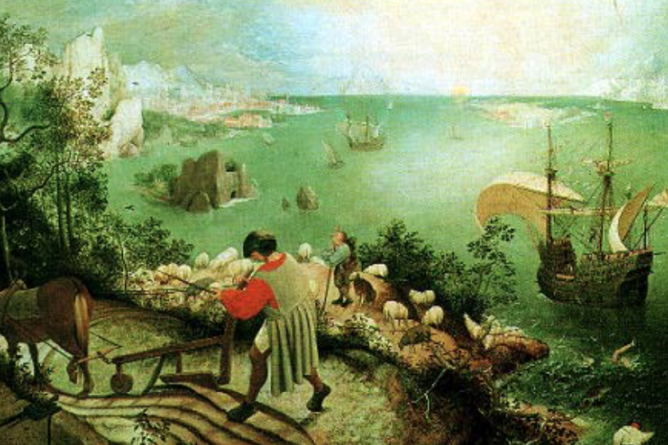
In Breughel's Icarus, for instance: how everything turns away
Quite leisurely from the disaster; the ploughman may
Have heard the splash, the forsaken cry,
But for him it was not an important failure; the sun shone
As it had to on the white legs disappearing into the green
Water, and the expensive delicate ship that must have seen
Something amazing, a boy falling out of the sky,
Had somewhere to get to and sailed calmly on.

About Suffering

In that first apartment, dank 
Baltimore basement, 
I etched Auden’s poem onto
my tablecloth, shaking 

the flimsy table, 
pressing down in 
windowless gloom 
before climbing up into 

gray sunlight to
join the other would-be poets 
in our beige metal classroom 
tucked somewhere 

I can’t recall -- perhaps 
on the edge of that famous university 
known mostly for launching 
serious doctors. 

There, we pursued our 
dreadful martyrdom to art, 
glorified our untidy lives and 
mundane disasters, 

thought we could torture our 
unsuitable affairs and boring mistakes
into important failures. 
We imagined we were cheating

pain into poetry, weaving song
from meaningless suffering. 
. . . Now we are old, and nameless, and
at least one of us is a ghost. 

Breughel’s green water still hangs 
on its museum wall, 
and Auden's words echo there 
like dust, 

multiplied by the internet
to infinity.

Suggested soundtrack: Father John Misty, “Pure Comedy”

One

Pastoral
               -- William Carlos Williams

When I was younger
it was plain to me
I must make something of myself.
Older now
I walk back streets
admiring the houses
of the very poor:
roof out of line with sides
the yards cluttered
with old chicken wire, ashes,
furniture gone wrong;
the fences and outhouses
built of barrel-staves
and parts of boxes, all,
if I am fortunate,
smeared a bluish green
that properly weathered
pleases me best
of all colors.

                   No one 
will believe this
of vast import to the nation.

Pastoral

          no one 
will believe this
of vast import to the nation
          -- William Carlos Williams

it’s true. 
the images and lives that
obsess us are just 

leaves falling to 
a pond’s mottled surface:
they swirl in reds and yellows for 

a moment then
sink, swallowed, 
while the important air, stitched 

with busyness, rushes
past. but
there’s a beauty to this

unremarkable collection, 
i think, a sense that
we are part of some

strange and urgent 
return to an 
original stillness.

Suggested soundtrack: Anything by Chopin.